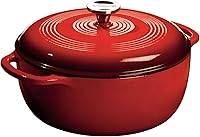
What Size Dutch Oven for One Person?
A 3 to 4.5 qt Dutch oven is the right size for one person. It holds a full pot of stew, a small loaf of bread or a two-person roast without taking over a solo kitchen. Choose 3 qt for tight shelf space and 4.5 qt for leftovers and batch cooking.
On this page (10 sections)
- Why is 3 to 4.5 qt the sweet spot for one person?
- What does each Dutch oven size hold?
- How heavy is a Dutch oven for one person?
- Which 3 qt Dutch oven suits a solo cook?
- Which 4.5 qt Dutch oven handles leftovers?
- Round or oval: which shape fits one person better?
- Enameled or bare cast iron for a one-person kitchen?
- Does a smaller Dutch oven save energy and space?
- How many quarts do you need for bread, stew and roasts?
- How to check fit in a one-person kitchen
A 3 to 4.5 qt Dutch oven is what size you'll want for 1 person in almost every kitchen. That range handles a pot of soup, a roast, rice for the week and a small loaf of bread without the weight and shelf space of a family pot.
Most Dutch ovens sold for homes run from 3 qt to 7 qt. A solo cook sits near the bottom of that range, but the right pick depends on how you cook, not just how many people you feed.
This guide breaks down capacity, weight, shape and features for one-person kitchens. You'll finish knowing which size to buy and which models deliver it.
Why is 3 to 4.5 qt the sweet spot for one person?
A 3 to 4.5 qt Dutch oven fits the meals one person cooks most. Capacity between 3 and 4.5 qt is enough for a full pot of stew, a batch of rice, a small boule or a two-person roast.
With some space left over, you get room to stir and simmer without hefting a heavy pan.
These pots run roughly 10 to 12 in across, so they sit on a single burner cleanly. They clear most oven racks and slide into a cabinet without a fight.
The size keeps browning efficient. Food fills the base rather than spreading thin, so onions and meat sear instead of steam.
It also limits cleanup. A large pot used for one serving leaves more surface to wash, and many enameled ovens are hand wash only.
A 3 qt pot suits single portions and sides. A 4.5 qt pot handles leftovers plus a dinner guest.
The four bigger sizes are worth a look only when your cooking leans toward batch work.
Buy in the 3 to 4.5 qt band unless you routinely feed a crowd or bake very large loaves. It is the best balance of room, weight and storage for one.
What does each Dutch oven size hold?
Sold sizes cluster in familiar steps, and each step changes how much food lands on your plate. A 3 qt pot holds about 3 quarts of liquid, which covers soup for two or three meals, and a 4.5 qt pot reaches about 4.5 quarts, enough for a batch that leaves leftovers.
Ounces help here. A quart holds 32 fluid ounces, so a 3 qt pot amounts to 96 fluid ounces of cooking volume.
That translates to workable portions of chili, curry or braise without filling the pot to the rim, since you'll want headroom for simmering.
Here is how the sizes compare for one-person use.
| Size | Best for | Fits a whole chicken? | Solo verdict |
|---|---|---|---|
| 3 qt | One servings, rice, sides, small bread | Only a small bird | Great for tight kitchens |
| 4.3 to 4.5 qt | Leftovers, two servings, small roast | Usually | Great all-rounder |
| 5 qt | Batch cooking, guests, large bread | Yes | More than most singles need |
| 7 qt | Large families, big batches | Yes, with room | Too big for solo cooking |
A 5 qt pot, as shown in this Lodge Dutch oven 5 quart review, is a common first buy. It is a solid pan, but for one person it uses more space and heavier lifting than needed.
The rule: pick 3 qt for single portions and tight cabinets; pick 4.5 qt for leftovers and the occasional guest. Save 5 qt and up for cooks who batch a week of food at once.
How heavy is a Dutch oven for one person?
A smaller Dutch oven is lighter, and that matters when you lift it hot. A 3 to 4.5 qt enameled Dutch oven usually runs around 10 to 11 lb, against 12 lb or more for 5 qt and larger pots.
The difference shows when you pull a full pan from the oven.
Cast iron gets heavy fast. Even a modest 3 qt pot weighs within a few pounds of a 5 qt model, because the walls and lid use similar material.
That's why handle design and lid weight affect daily use as much as capacity.
Wide loop handles help you grip with oven mitts. A stainless steel knob is safe at high heat, while some plastic knobs carry lower temperature limits.
A tight-fitting lid with self-basting dots keeps moisture in, so you'll open the pot less often.
Check the weight before buying if you have wrist or shoulder limits. Lighter pans mean less strain on oven trips.
Weigh the lift before the capacity. If you cook alone and lift a full pot often, a 3 qt oven with wide handles will feel easier than a bigger one with the same weight.
Which 3 qt Dutch oven suits a solo cook?
A 3 qt pot is the smallest size most cooks need, and it fits the solo kitchen with the least space. The E-far 3 Qt is the clean starting point for one person, with a compact round body and an enamel finish that needs no seasoning.
E-far builds it from enameled cast iron, which resists rust and handles acidic foods without a seasoning routine. The white interior makes it easy to watch browning.
It works on induction and in the oven, and E-far rates it safe to 450 degrees Fahrenheit. The 3 qt body holds rice, pasta, soups and small casseroles.
The catch is its size. A 3 qt round suits one person but gets crowded with a full chicken or a big batch of chili.
It is best when you cook in modest amounts.
Pick the 3 qt E-far for a small kitchen and single portions. If leftovers are part of your week, move up to a 4.5 qt pot.
For more small ovens, see our guide to the 3 qt Dutch ovens.
Which 4.5 qt Dutch oven handles leftovers?
A 4.5 qt pot adds room for a second serving or a few days of leftovers, and two strong candidates sit in this size. The Amazon Basics 4.3-Quart and the MUELLER HOME 4.5 QT both cover solo cooking with room to spare, and each handles a small roast or a full pot of stew.
Amazon Basics builds this round pot from cast iron with an enamel finish. It distributes heat evenly and is rated oven safe to 500 degrees Fahrenheit, which covers bread baking and searing.
The brand describes it as ideal for serving 3 to 4 people, so for one person it leaves generous room for leftovers. It's hand wash only, like most enameled pots.
The MUELLER HOME 4.5 QT is the larger of the two in name, and it carries a self-basting lid with raised nodes that return moisture to the food. Its glossy enamel resists rust and works as a natural non-stick interior.
Mueller says it works on all cooktops, including induction, and in the oven to 500 degrees Fahrenheit. Wide handles and a stainless steel knob help with lifting.
Choose Amazon Basics for a simple round pot and MUELLER HOME for a self-basting lid. Both suit one person who cooks a few servings at a time.
If you also want a pan plus a pot, look at a double Dutch oven.
Round or oval: which shape fits one person better?
Round is the default for solo cooking, but oval has a place for certain foods. A round Dutch oven suits most one-person meals because it fits a single burner and most oven racks and browns evenly across the base.
Round pots match stews, soups, rice, casseroles and bread. The even circle of heat keeps the cooking surface consistent, and the shape stacks well on a shelf.
Oval ovens are longer, which helps with whole chickens, fish and roasts. For one person, an oval pot can hold a chicken that a round 3 qt pan would crowd.
The trade-off is burner coverage. An oval pot overhangs a round burner, and the heat pattern changes when you sear.
Most enameled Dutch ovens come in round shapes, including the products above. The E-far and the other pots here are all round, so oval will mean a separate search.
Stay round for solo cooking unless whole roasts and fish are regular meals. If you bake bread and make stew most weeks, round serves you better, while oval earns a spot for roasts.
Enameled or bare cast iron for a one-person kitchen?
Enameled cast iron wins for most solo cooks, with bare cast iron for specific jobs. Enameled Dutch ovens need no seasoning and resist acidic foods, which makes them easier for one person who cooks tomato, wine or citrus dishes and doesn't want a maintenance routine.
The enamel also makes cleanup simpler. A white interior shows browning, and food releases with less sticking.
Bare cast iron has its own strengths. It takes very high oven heat, suits bread baking and stays affordable.
It also needs seasoning and benefits from dry storage.
Which one fits you depends on how often you cook. An occasional cook will value the no-seasoning enamel.
A regular bread baker might prefer the rugged character of bare iron.
Care matters in either case. Hand wash enameled pots in warm, soapy water and avoid metal utensils and citrus-based cleaners to protect the finish.
For the bare-iron side, our guide to the cast iron dutch oven covers what to look for.
Pick enameled for easy everyday cooking; pick bare cast iron for bread and budget. For one person, enameled cast iron removes the most friction from weeknight meals.
Does a smaller Dutch oven save energy and space?
A smaller Dutch oven uses less of your stove, oven and cabinet. A 3 to 4.5 qt pot heats up faster than a 5 or 7 qt pan, and it leaves more shelf and oven room in a compact kitchen.
Cast iron holds heat for a long time. Once a small pot reaches temperature, it keeps food warm after the burner goes off, so you use less energy on reheat.
Storage is the other win. A 3 qt round pot fits on a narrow shelf or in a low cabinet.
A 7 qt pan needs a wide spot.
Oven space matters if you cook in a small or countertop oven. A lower-capacity pot clears racks more easily.
Smaller also means less wasted food. A pot sized to one serving encourages sensible portions.
Weigh the upside against limits. A small pot can't hold a large batch or a big roast.
Go small to save energy and space; go larger only when your cooking demands it. For a solo kitchen, a compact enameled pot earns its shelf space every week.
How many quarts do you need for bread, stew and roasts?
Your meal list decides the size, and three common dishes point to different capacities. A 3 qt pot suits small bread, sides and soups, while a 4.5 qt pot handles roasts and larger loaves.
Match the pot to the dish you cook most.
For bread, a round 3 to 4.5 qt pot holds a boule that lasts one person several days. The lid traps steam, and the pot's heat helps the loaf rise.
For stew and chili, 3 qt gives you two or three servings with headroom. A 4.5 qt pan lets you store leftovers in the same pot.
For roasts, a 4.5 qt oven fits a small roast or chicken. A 3 qt pan crowds larger cuts, so choose by the biggest thing you plan to cook.
Think through a normal month. If soup and rice fill your weeks, 3 qt is enough.
If roasts, bread and batches of food are common, size up.
The decision rule is simple. Match the pot to your most common large dish, not the smallest one.
Then you'll avoid buying twice.
How to check fit in a one-person kitchen
Fit decides how often a Dutch oven leaves the shelf. Measure your shelf, stove burner and oven rack before you buy, and compare them with the pot's outside dimensions and handles.
Start with the store spot. A 3 qt round pot takes less shelf room than a 5 qt, and its size is easier to move.
Check the burner. A round pot should sit on one burner without overhang.
Oval pans need more burner width.
Measure oven clearance. Handles and a lid knob add height, so make sure the pot sits on a rack with the door closed.
Consider the lift. A smaller pot is easier to move with oven mitts.
E-far lists its 3 qt pot at about 11.6 in across with handles, so measure your cabinet depth against that figure.
Mark the shelf and the rack before ordering. A pot that fits lowers daily effort, which keeps it in use.
When a pot doesn't fit, it ends up buried at the back of a cabinet.
You now have a clear answer for what size dutch oven for 1 person. Choose 3 qt for single portions, small bread and a tight kitchen.
Choose 4.5 qt for leftovers, small roasts and bread with room to spare.
If you want the simplest start, the E-far 3 Qt covers most solo meals. If you cook in batches or host now and then, step up to a 4.5 qt pot like the MUELLER HOME.
For a bare-iron option and the broad field of pots, our cast iron Dutch oven guide is the next read.
Frequently asked questions
Is a 3 qt Dutch oven big enough for one person?
Yes, 3 qt covers most solo cooking. It fits a pot of chili, a small sourdough loaf, rice for several meals and a two-person roast.
Pick it if you cook single portions, have a small oven or store cookware on narrow shelves.
Can one person use a 5 qt Dutch oven?
You can, but a 5 qt pot is more capacity than solo cooking usually needs. It makes a heavy pan for one or two servings and takes up shelf and oven space.
Choose that size if you regularly cook for guests or bake large loaves.
Is enameled or bare cast iron better for a solo cook?
Enameled cast iron suits one person who cooks tomato sauces, wine braises or citrus dishes, because the finish resists acidic foods and needs no seasoning. Bare cast iron is a good fit if you want low-fuss bread baking and don't mind seasoning the pot.
What is a good size Dutch oven for baking bread for one?
A 3 to 4.5 qt round Dutch oven bakes a boule that serves one person for several days. Smaller rounds keep the loaf close to the sides, which helps it hold height.
Choose the size that fits your loaf shape and your oven rack.
Can I cook a whole chicken in a 3 qt Dutch oven?
A small chicken can fit, but most whole birds need a 4.5 qt pot or larger. For one person, a smaller chicken, thighs or a half chicken fit a 3 qt pot more reliably.
Measure the bird against the interior before roasting.