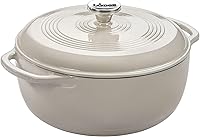
What Size Dutch Oven for 4 People?
For a household of 4, a 4-quart Dutch oven covers most meals, with enough room for a stew, a braise or a batch of soup. Step up to 5 or 6 quarts if you cook whole chickens, bake bread often or want leftovers built in.
On this page (10 sections)
- What size Dutch oven feeds 4 people?
- Is a 3-quart Dutch oven enough for four?
- Why round or oval changes the answer
- How many quarts for four people who love leftovers?
- Which pot fits a table of four?
- How do you confirm a pot feeds four before buying?
- Do four people need a second Dutch oven?
- What about smaller households or bigger tables?
- How do you care for a 4-quart pot?
- Which size should you buy for 4 people?
The best size Dutch oven for 4 people is 4 quarts, because that amount holds a stew, a braise or a soup for four with room to stir. It also bakes a round loaf, roasts a small chicken and moves from stove to oven to table without a second pot.
A 4-quart pot is the middle of the cast iron range: small enough to heat quickly, big enough to feed a family. If you regularly cook for four and want leftovers, pick 5 to 6 quarts instead.
This guide works through the sizes, the shapes and the cooking jobs that change the answer. It ends with the pot to buy if you want one that does the most for a table of four.
What size Dutch oven feeds 4 people?
Choose 4 quarts as the default for four servings, and move to 5 or 6 quarts when your portions run large or you want food left over. Capacity is the whole answer here, so start with the number and work outward.
Dutch oven capacity is measured in quarts, and a quart is about 4 cups. A 4-quart pot holds roughly 16 cups to the brim, but you never fill it to the rim: leave an inch or two of headroom so the lid seats and the contents don't boil over.
A typical serving of stew or chili is about 1 to 1.5 cups, so four servings use 4 to 6 cups of finished food. That leaves plenty of volume in a 4-quart pot for liquid, vegetables and meat as they break down.
The tighter cases are the ones to watch. A soup recipe that starts with 8 cups of stock plus vegetables and protein can push a 4-quart pot close to its limit.
A pot of dried beans that triples in size as it soaks and simmers needs more room than the finished dish suggests.
So the size question has two honest answers. 4 quarts fits four people for a dense braise or a thick stew.
5 to 6 quarts fits four people for brothy soups, big pasta batches and any meal where you want a second helping the next day.
Pick 4 quarts if your recipes are in the middle and you serve four at one sitting. Pick 5 or 6 if your four includes teenagers, athletes or a house that eats leftovers.
The rule is firm: size to the batch you actually cook, not to the number on the box.
Is a 3-quart Dutch oven enough for four?
A 3-quart pot is too small for most four-person meals, though it works for sides, sauces and small batches. The limit is stirring room, not just volume.
A 3-quart pot holds about 12 cups to the brim. Once you leave headroom and add a stew that needs to be stirred without sloshing, you're cooking for two or three comfortably.
The clearest test is a whole chicken. A small bird in the 3 to 4 lb range can fit in some 3-quart pots, but a 4 to 5 lb chicken for four people needs a 4-quart pot or larger, and an oval shape helps.
Where a 3-quart pot earns its place is beside a bigger one. It handles rice, a pot of beans for a side, applesauce or a batch of caramel.
It's a good second pot and a poor only pot for a family of four.
Buy 3 quarts only if your portions are modest and you cook dense, low-liquid dishes. Otherwise put the money toward 4 quarts and add a small pot later.
Why round or oval changes the answer
A round Dutch oven is the better first pot for four people, because it suits stews, soups, braises and bread. An oval pot wins for whole birds and long cuts.
Round pots heat evenly around the whole base and let a round lid seal without gaps. They fit on a burner without overhang and sit in the middle of an oven rack.
For a soup or chili, round is the natural shape.
Oval pots are longer front to back, so a whole chicken, a leg of lamb or a rack of ribs lies flat without being bent or cut. That matters when the bird is the centerpiece.
The trade-off is a longer footprint on the stove and a shape that can crowd a small oven.
For a four-person household buying one pot, round in 4 to 5 quarts covers the most meals. Add an oval later if roasts and whole birds become a regular Sunday job.
Our guide to the best cast iron Dutch ovens covers both shapes across brands.
If bread baking is the goal, round is the shape to choose. A round boule drops into a round pot without stretching, and the high sides trap steam.
The rule: buy round first, add oval for whole birds and long roasts.
How many quarts for four people who love leftovers?
Plan for 5 to 6 quarts if leftovers are part of the plan. Four servings eaten now plus four saved doubles the batch, and a 4-quart pot gets crowded.
Doubling a recipe is where size math gets practical. If your go-to chili makes four servings in a 4-quart pot, a double batch needs 6 to 8 quarts, or two pots.
Most four-person homes that cook once and eat twice land on 6 quarts. It holds a doubled stew, a big pot of soup and enough pasta sauce for two dinners, and it still works for a single batch.
The cost of going bigger is heat time and weight. A 6-quart cast iron pot takes longer to come up to temperature and is heavier to lift when full.
For most adults that's a fair trade for a second meal.
If you rarely save food, stay at 4 quarts. If your freezer fills with containers after every cook, size up.
The rule: one dinner, buy 4 quarts; two dinners, buy 6.
Which pot fits a table of four?
The STAUB 4-qt round cocotte is the pick for most four-person kitchens because its capacity matches the job and its enamel works on every stovetop. The two other pots below are the right choice for specific cooks.
STAUB says this 4-qt round cocotte serves 3 to 4 people, which lines up with the default size above. The lid has tiny spikes on the inside that release condensed liquid back onto the food, so a braise stays moist.
The interior has a matte texture that browns meat well, and the smooth enamel bottom works on gas, electric, glass ceramic, induction and halogen. The pot is oven safe to 900F without the lid and the lid is safe to 500F.
It weighs 4.1 kg (about 9 lb), light enough for most people to lift from oven to table. STAUB recommends hand washing, and the cherry enamel finish looks right on a dinner table.
Staub says this round 4-qt model serves 4 to 6 people, a wider range than the pot above, so it suits four adults with big appetites. The flat lid has self-basting spikes and the black matte interior resists scratches and needs no seasoning.
The nickel or brass knob is heat resistant to 500F, and the smooth bottom suits induction. This pot is dishwasher safe, which is handy for a family kitchen, and it weighs 4.8 kg (about 10.6 lb).
If you read the serving range and wonder about the difference, the two 4-quart pots measure the same across the width but the maker's serving guidance differs. Trust your own portion sizes over the label.
Le Creuset's 4.5-quart round Dutch oven is the other strong candidate for four. The light colored smooth interior lets you watch food brown and judge a sauce by sight, which the dark interiors hide.
The brand says the enamel resists dulling, staining, chipping and cracking, and the tight lid circulates steam back onto the food. Ergonomic knobs and handles help with lifting, and it's oven safe to 500F and dishwasher safe.
Le Creuset backs it with a limited lifetime warranty.
The pot weighs 8.8 lb, the lightest of the three, which matters if you move it often. The extra half quart adds a little headroom for soup without changing the footprint much.
How do you confirm a pot feeds four before buying?
Measure the interior depth and width, not just the quart rating, because pot shape changes usable room. A tall narrow 4-quart pot and a wide shallow one hold the same volume but cook differently.
Check the inside diameter first. A wider pot gives more searing surface, so you can brown meat in fewer batches.
A narrower, deeper pot holds more liquid above the food for braising, but browns less at once.
Look at the interior finish too. Dark matte enamel hides stains and browns well.
Light enamel shows browning clearly and helps when you're learning to judge a fond. Both work, and the choice is preference.
Height matters for the oven. A tall pot with the lid on needs rack clearance, especially under a broiler.
Measure your oven's interior before you buy a large pot.
Weight is the other check. A 6-quart cast iron pot full of stew weighs a lot more than the empty figure, so lift the empty pot at the store if you can, or compare the listed weights.
The rule: match the pot to your recipes and your lifting, then let the quart number confirm it.
Do four people need a second Dutch oven?
A second Dutch oven helps if you cook two components at once, such as a braise and a pot of rice, or if you bake bread alongside dinner. Most homes can wait.
The common pairing is a large pot and a small one. A 6-quart for the main dish and a 3-quart for sides covers more meals than two mid-size pots.
A double Dutch oven or combo cooker does the same job in one purchase: a shallow pan that doubles as a lid or skillet.
A second pot also solves oven space. Two pots in the oven at once need rack space and clearance for both lids.
Check your oven before you plan a two-pot dinner.
If bread is your reason, a smaller dedicated pot can be the second buy. A round 4-quart does a boule, and a covered baker does more.
The question of heat limits is worth a look: our guide on are Dutch ovens oven safe covers what each part of the pot can take.
The rule: buy the large pot first, then add a small one for sides and bread.
What about smaller households or bigger tables?
If your usual table is two, a 2.5 to 3-quart pot is the smarter buy, and our guide to the best Dutch oven for 2 people has the picks. It heats faster and weighs less.
A four-person household buying for two is a common mismatch. The pot that fits two comfortably leaves a four-person dinner crowded, so decide the usual number at the table.
Going the other way, a table of six or more needs 6 to 7 quarts. A 4-quart pot can still work for a dense braise, but soup for six pushes past its limit.
Many homes solve this with two sizes: a 5-quart everyday pot and a 7-quart for gatherings. That pair handles a family of four through holidays without buying a pot for every headcount.
The rule: size to your usual number, and add one bigger pot for guests.
How do you care for a 4-quart pot?
A 4-quart enameled cast iron pot needs little more than warm water and a soft sponge, and it should never go from hot to cold water. Treat the enamel with care and it lasts for years.
Let the pot cool before washing. A hot pot plunged into cold water can crack the enamel.
Warm water and a little dish soap handle most food, and a nylon scraper lifts stuck bits without scratching.
The dark matte interiors on the Staub pots need no seasoning, and the enamel resists rust and discoloration. The light Le Creuset interior shows stains more, though the brand says its enamel resists staining.
A baking soda paste handles marks.
Mind the heat limits. Enameled cast iron is oven safe, but the lid limits vary by brand and knob.
Dry heating an empty pot can damage the enamel, so add fat or liquid first.
A 4-quart pot is also a serving dish, so it goes from oven to table and saves a platter. Set it on a trivet or a folded towel, not a cold counter.
The rule: cool first, wash gently, and respect the heat limits.
Which size should you buy for 4 people?
Buy a 4-quart round Dutch oven if four is your usual table, and it will handle stews, braises, soups, roasts and bread. Choose 5 or 6 quarts when leftovers, whole birds or big soup batches are part of your week.
The deciding factor is your cooking pattern, not the headcount alone. A house of four that eats one dinner and moves on does well with 4 quarts.
A house of four that cooks for two dinners needs 6.
If you want one pot that covers the most, buy the 4-quart. If you want the most capacity for the money and can lift the weight, buy 5 to 6 quarts and cook bigger batches.
When the answer is still close, size up. A slightly larger pot works for four and for six, while a too-small pot can't be stretched.
The firm rule for the question of what size Dutch oven for 4 people: 4 quarts for one meal, 5 to 6 quarts for one meal plus leftovers. Get that right and the brand and color are the easy part.
Frequently asked questions
Is a 4-quart Dutch oven big enough for 4 people?
Yes, for most meals. A 4-quart pot holds a stew, soup or braise for four with a little room at the top.
Go bigger when you cook whole birds, bake bread or want planned leftovers.
Should I buy a round or oval Dutch oven for a family of four?
A round pot suits stews, soups and bread. An oval pot fits whole chickens, leg of lamb and longer cuts that a round pot forces you to bend or cut.
For most four-person kitchens, round is the more useful first pot.
How heavy is a 4-quart cast iron Dutch oven?
Weight varies by brand. The STAUB 4-qt round cocotte is 4.1 kg (about 9 lb), and the Staub 4-qt model is 4.8 kg (about 10.6 lb).
That weight is manageable for one person to lift, but try it in your hands if lifting is a concern.
Can I cook for 4 people in a 3-quart Dutch oven?
Sometimes, for smaller portions. A 3-quart pot is tight for a stew or soup for four once you leave room for stirring, and it cannot fit a whole chicken.
Buy 4 quarts or more if four servings is your normal batch.
Does a bigger Dutch oven cook food differently?
Yes, in a practical way. A wider pot exposes more surface to heat, so liquid reduces faster and food browns over more area.
A 4-quart pot is a middle ground: deep enough for braising, wide enough to sear in stages.